



The Illusion of Agility
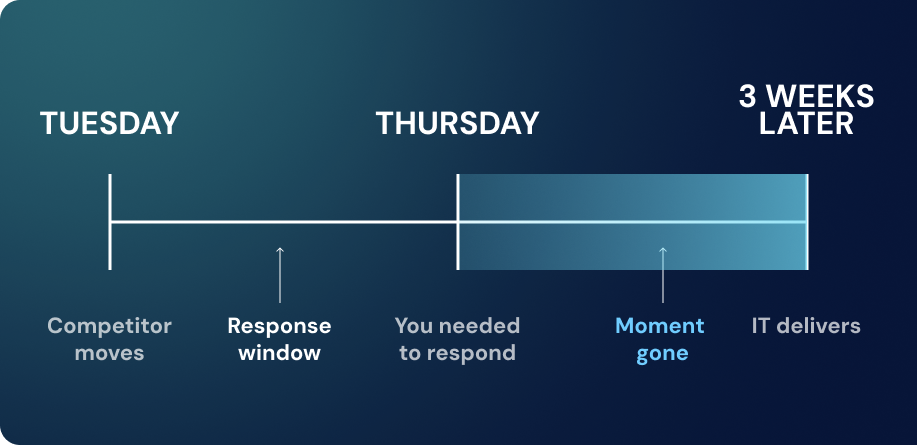
It’s Tuesday. A competitor ships a new feature and tweaks their pricing. Your team wants to respond by Thursday with a new discount tier, a short-term bundle, or a specific guardrail change on one product line. This is routine commercial strategy.
So you open a ticket.
IT replies fast: The next slot is three weeks out. Between the Salesforce backlog, infrastructure priorities, and “best effort” sprints, your pricing change is in a queue.
By Thursday, the field is moving anyway. Some reps are quoting off-system. Some are using an old spreadsheet. Some are asking a manager in a Slack thread who is guessing based on a conversation from last month.
Terms drift. Discounts leak. Your message to the market is no longer yours, it is whatever the rep could manage in the dark.
Three weeks later, the change finally lands in the system. But the moment is gone. The campaign ended. Reps moved on. In the pipeline review, leadership asks why the response didn’t land.
You already know why: You don’t own your execution layer. Your IT ticket queue does.
The AI Execution Era: Why the Logic Layer Belongs to RevOps
RevOps is held to the number: forecast accuracy, deal speed, margin protection, and clean data. But accountability without control isn’t ownership; it’s exposure.
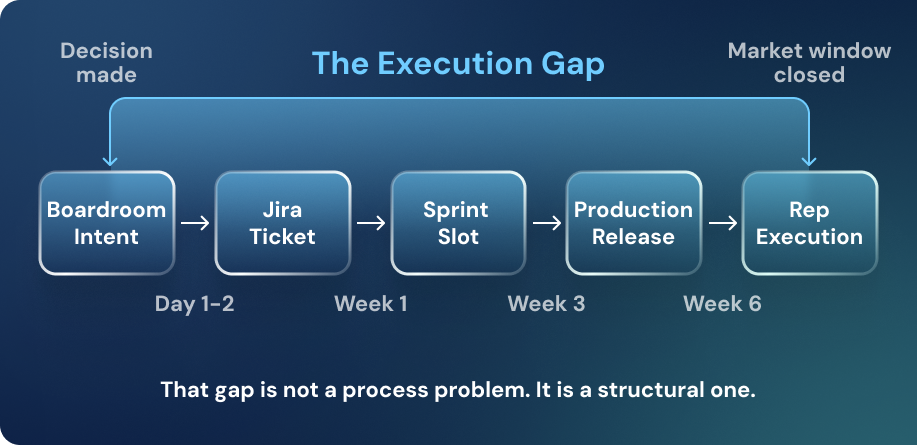
In most organizations, the mechanics that create those outcomes live somewhere else entirely. Pricing rules, approval thresholds, and product bundles are buried in technical infrastructure that requires a developer to modify. Every commercial decision has to survive a translation; from boardroom intent to Jira ticket to sprint slot to production release. That gap between decision and execution is where market windows close and rep workarounds begin.
This is the Execution Gap. And it’s not a process problem. It’s a structural one.
The shift to a Revenue Architect model doesn’t require a new org chart or a new title. It happens the moment you decouple commercial logic from technical infrastructure, giving RevOps direct ownership of the execution layer. When the people accountable for the number can also set, update, and enforce the rules that govern it, the Execution Gap closes. That’s the difference between managing revenue and owning it.
When you don’t own the logic, you are not able to truly architect your revenue execution. Rather, you become a ticket-taker waiting for someone else’s sprint to end.
When AI Ambition Hits a Gated Logic Layer
Many companies fall for the “Standardization Illusion.” They assume that consolidating every commercial rule into their primary CRM ecosystem is “clean.” In reality, they are buying Rigidity. If every adjustment to your GTM strategy requires a six-week release window, you haven’t simplified your business, you have actually frozen it.
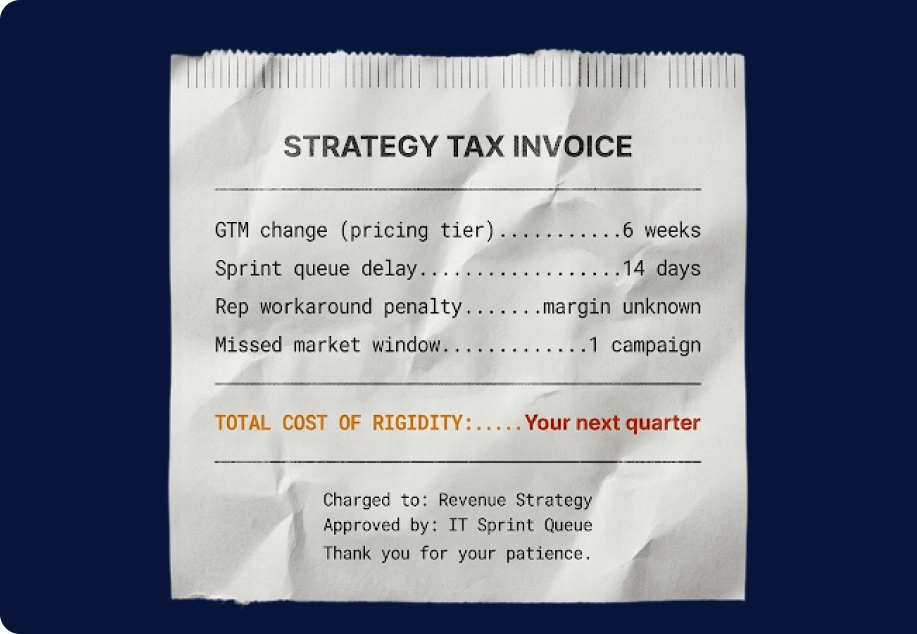
- Rigidity is a Tax on Strategy: It forces the business to move at the speed of a developer’s sprint — not the speed of the market.
- Adaptability is a Competitive Weapon: It’s the ability to decide on a strategy in the morning and have the field quoting it by lunch.
What AI-Ready Revenue Execution Looks Like When RevOps Governs the Logic
IT-Gated Model |
RevOps-Owned Model |
|
|---|---|---|
Logic Ownership |
IT / Developers — rules buried in code, every change needs an engineer |
RevOps. No code — set, update, enforce rules directly, no ticket required |
Pricing Updates |
A 3-week project — sprint planning, regression risk, release window you don’t control |
A 10-minute update — made by the business owner, live before the competitor’s campaign ends |
Approval Flows |
Static rules reps bypass — approvals in Slack, policy already ignored |
Dynamic policies that evolve — reps can’t send what isn’t sanctioned |
Product Launches |
Delayed by release windows — next sprint is the ceiling on GTM speed |
Live on the Go signal — strategy decided, logic set, field quoting, same day |
Data Integrity |
Garbage in by default — system of record always behind the deal |
Clean by default — system captures while it governs, no reconciliation |
AI Readiness |
AI has no governed logic to act on — it automates the workaround |
Governed rules become AI operating instructions — the execution layer is the instruction set |
The Revenue Architect is already in the room. What’s missing isn’t authority, it is control over the system that enforces it.
Building the Governed Execution Layer that AI Can Trust
There is a second-order consequence to closing the Execution Gap that most RevOps leaders aren’t yet pricing in. When commercial logic lives in a governed, business-owned layer, it becomes machine-readable. AI can act within your pricing guardrails rather than around them. The companies building agentic quote-to-revenue workflows in 2026 are not starting with AI — they are starting with a clean execution layer that the business owns and AI can trust.
The shift isn’t a new org chart. It’s a shift in where the rules live.
Owning your revenue execution means the system enforces the rules you set, from quote build to revenue recognition, without waiting on a queue or breaking rules that were created during last quarter’s development sprint. The companies building Agentic Quote-to-Revenue workflows in 2026 are not starting with AI, they are starting with a clean execution layer that the business owns and AI can trust. Agentic Quote-to-Revenue is the architectural model in which AI agents operate within governed commercial logic across the full deal lifecycle: from configure-price-quote through contract, subscription, and billing — with every action traceable, every rule enforced, and no human required to bridge the gap between intent and execution.
Where Your AI Governance Decision Gets Made
But before any of that becomes possible, there’s a more immediate question to answer.
Let’s go back to Tuesday.
The competitor moved. Your team had the right response. What failed wasn’t the thinking, it was the distance between the decision and the system that was supposed to execute it.
That distance isn’t inevitable. It’s a structural condition. It shows up as a three-week ticket queue. A spreadsheet in someone’s Downloads folder. A pipeline review where leadership asks why the response didn’t land.
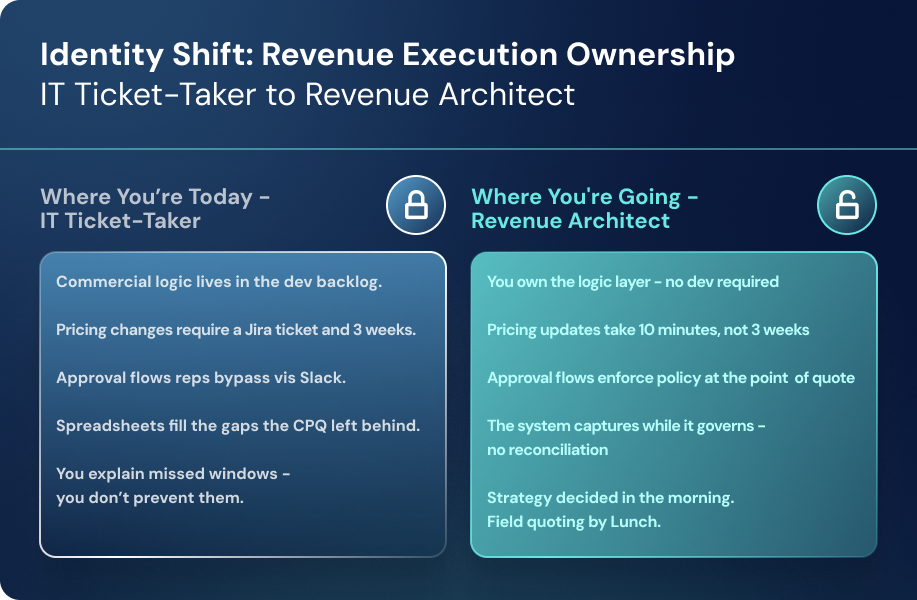
The organizations closing that distance aren’t hiring faster or escalating louder. They’re changing where the rules live — moving commercial logic out of the dev backlog and into the hands of the people accountable for the outcomes it creates.
This is the only question that matters. Not a new tool. Not a new title. Where do the rules live, and who is allowed to manage them?
The audit below is where that assessment starts: not to build a vendor business case, but to name precisely where your commercial logic is trapped and what it’s costing you every week it stays there.