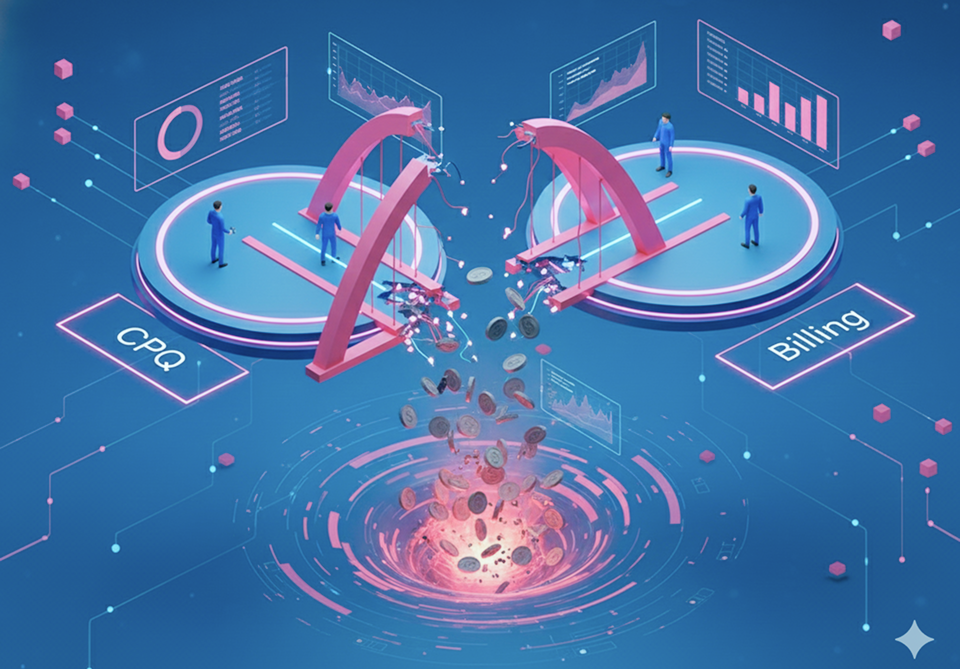

Your sales reps are talented and motivated, yet they’re losing deals. It’s not because of the competition, but because of the quote process itself. While they’re busy building relationships and moving opportunities forward, manual quoting workflows are working against them: pricing errors that require revisions, approval requests that sit unanswered, and disconnected tools that force reps to re-enter the same data three times before a quote ever reaches a prospect.
The result? Deals stall. Cycles stretch. Revenue leaks from a process that should be a competitive advantage.
The good news is that this isn’t a people problem; it’s a systems problem. And systems can be fixed.
Automating SaaS quote generation removes friction across your entire quote-to-revenue motion, from the moment a rep starts configuring a deal to the moment a contract is signed and billing begins.
What powers SaaS quote automation?
Quote automation is the use of software to handle the configuration, pricing, approval routing, and document generation that make up the quoting process, without manual intervention at each step. Instead of a rep toggling between spreadsheets, email threads, and PDF templates, the system handles the logic: applying the right pricing based on the deal parameters, flagging exceptions that need approval, and producing a polished, compliant quote document ready for the customer. For teams that aren’t ready for a full platform, a faster way to streamline this is to convert a pdf to a link for instant, trackable sharing with the buyer.
The engine behind quote automation is CPQ (Configure, Price, Quote) software. CPQ platforms are purpose-built to manage the complexity that makes SaaS quoting so difficult: tiered seat pricing, usage-based billing, multi-year contract terms, regional variations, and the endless combinations of add-ons and bundles that define modern SaaS offerings. Rather than leaving that complexity to individual reps to sort out manually, CPQ encodes the logic once and applies it consistently across every deal.
But for SaaS companies managing the full revenue lifecycle, CPQ alone isn’t enough. The most effective implementations extend CPQ into contract lifecycle management (CLM), e-signature, and subscription billing — creating a single governed flow where every step from quote to cash operates on the same data, the same rules, and the same platform.
DealHub is built for exactly this: a unified quote-to-revenue platform that enables revenue teams to execute without the handoff delays inherent in traditional stacks.
Follow these 7 steps to automate SaaS quote generation
Step 1: Get your product catalog in order
Automation is only as reliable as the data it runs on. Before you configure a single pricing rule or build an approval workflow, your product catalog must be complete and up to date. Commonly referred to as SKU hygiene, this is the unglamorous foundation that determines whether your quote automation delivers or disappoints.
For companies with a SaaS revenue model, a well-maintained catalog means every plan, add-on, user tier, professional services offering, and regional variant is documented with accurate, standardized information. When reps build quotes from a pre-approved catalog, they’re working from a single source of truth: no quoting discontinued products, no applying the wrong pricing to the wrong region, and no surprises when the deal moves to billing.
A structured catalog record should include, at a minimum:
- SKU / Product ID
- Description
- Pricing type (one-time, recurring, usage-based)
- Region and currency
- Availability status
- Compatible add-ons and bundles
The investment in maintaining accurate product configuration pays compounding returns. Get this right first, and every step that follows gets easier.
HP’s 3D Printing division learned this firsthand. Managing 500+ SKUs, each requiring compatibility logic across at least 25 components, their team was trying to run quotes through Excel files and email chains. The result was a system that couldn’t keep pace with weekly product changes and pricing updates that took up to three months to push through. Once HP 3D Printing centralized its catalog and product logic in DealHub CPQ, that same update now takes under an hour. When your catalog is clean and your logic is centralized, the entire quoting operation is faster and more accurate.
Step 2: Encode your pricing rules
SaaS pricing is complex by nature. Seat tiers, usage-based fees, multi-year contract terms, regional variations, volume discounts, and negotiated overrides — the permutations are endless. When that logic lives in a spreadsheet or in a senior rep’s memory, every quote risks inconsistency, margin erosion, and deals closing with the wrong price.
Encoding pricing rules in a CPQ rules engine solves this at the source. You define the logic once, such as how pricing should respond to user count, billing cadence, add-ons, volume thresholds, and contract-specific overrides, and the system applies it consistently across every quote.
Common SaaS pricing inputs your rules engine should account for:
- Plan type and feature tier
- Number of seats and user thresholds
- Add-ons and bundle configurations
- Term length and billing cadence (monthly, annual, multi-year)
- Usage tier and overage rates
- Region and currency
- Negotiated contract price overrides
That last point matters more than most teams realize. When negotiated contract pricing isn’t encoded as an override, reps default to standard tier pricing , and that inconsistency creates both margin risk and customer trust issues.
The business case for getting this right is significant. According to McKinsey, technology-enabled pricing transformations can generate 2–7 percentage points of sustained margin improvement, with initial benefits appearing in as little as three to six months. Encoded pricing logic and pricing automation are the foundation of that transformation, eliminating the guesswork and protecting margins at scale.
Step 3: Configure guided selling workflows
Even your best reps make configuration mistakes under pressure. Missed dependencies, skipped upsell prompts, and incompatible bundles create revision cycles, and signal to buyers that your sales process isn’t as sharp as your product. At scale, the problem compounds: inconsistent quoting across a large team means inconsistent margins and customer experiences.
Asure, an HCM solutions provider managing 500+ SKUs, experienced this problem directly. Without guided selling workflows, reps produced vastly different quotes from the same product catalog — forecasting was unreliable, upsell opportunities were missed, and new reps took over 12 months to ramp. After implementing DealHub’s dynamic playbooks, which walked reps through structured discovery to ensure every quote had the right pricing and product mix, Asure cut training time by 85% and increased rep productivity by 20%. Reps went from taking a year to get up to speed to quoting the full product suite within weeks.
Guided selling inside DealHub CPQ walks reps through the process of creating valid quotes, surfacing compatible products, enforcing dependencies, prompting relevant bundles, and flagging approval requirements before a quote ever reaches the customer.
A well-configured guided selling workflow moves through four stages:


Guided selling gives reps back the time and cognitive bandwidth to focus on the conversation in front of them, not the configuration behind it.
Step 4: Automate approval workflows
Approval bottlenecks are one of the most common and preventable causes of deal stall. A rep submits a quote with a non-standard discount. It goes to a manager’s inbox. The manager is traveling. Three days later, the prospect has gone cold.
The problem is the absence of structure around approvals. When approval routing is manual and ad hoc, deals wait on people instead of processes.
Zapier’s experience illustrates exactly what’s at stake when approval structure is absent. Their entire approval process, covering legal, finance, and sales sign-offs, ran through a single 100-node HubSpot workflow built and maintained by one admin. If that person was unavailable, deals stalled. If a node misfired, approvals disappeared into inboxes with no visibility into where things stood. After implementing DealHub’s parallel approval flows with built-in SLA tracking, approval cycles collapsed from multi-day delays to a predictable turnaround of eight hours or less; every step was logged, timestamped, and audit-ready.
A typical automated approval flow looks like this:
Discounts beyond a defined threshold route to a sales manager. Non-standard contract terms route to legal. Deals above a certain value trigger a multi-level approval. All of it happens automatically, with full audit trail visibility so RevOps can see exactly where deals are at any point in the process.
The governance benefits extend beyond speed. Documented approval trails protect margin discipline, support compliance requirements, and give leadership confidence that exceptions are being reviewed.
Step 5: Standardize document templates and e-signature
A quote document is often the first formal representation of your company that a buyer receives after a sales conversation. If it looks like it was assembled manually, it introduces doubt at exactly the wrong moment.
Standardized quote templates eliminate this risk. When document generation is automated within your CPQ platform, every quote that leaves your team is accurate, branded, and complete. They’re populated automatically with the configured products, pricing breakdown, applicable taxes, legal terms, and expiration date based on the deal parameters already in the system.
Key components every SaaS quote template should include:
- Product and service configuration summary
- One-time vs. recurring charge breakdown
- Applicable taxes and fees
- Legal terms and conditions
- Quote expiration date
- Version history
Connecting document generation directly to e-signature completes the motion. Rather than downloading a PDF, attaching it to an email, and waiting for a DocuSign link to be processed separately, the buyer receives a single, seamless experience. According to DocuSign, customers report an average reduction in contract turnaround time of 15 days and a 37% improvement in productivity. For deals where timing is everything, that compression matters.
Step 6: Connect CPQ to CRM, billing, and beyond
A quote automation system that operates in isolation isn’t really solving the problem — it’s just moving the manual work downstream. Reps still have to re-enter data into the CRM. Finance still has to manually trigger invoices. Operations still has to reconcile order details with fulfillment.
True quote automation requires integration: automated data synchronization between CPQ, CRM, billing, ERP, e-signature, and tax engines so that information flows continuously across every system without human intervention.


The downstream impact of getting integrations right is significant. When SourceScrub replaced its fragmented stack, which included Salesforce, S-Docs, and DocuSign operating as disconnected point solutions, with DealHub CPQ, quote turnaround time dropped by 94%. Creating a unified platform also saved $4,000 annually on redundant tools and reduced admin time. What once took eight minutes per quote now takes thirty seconds. That’s not a workflow improvement. That’s a structural redesign of how deals move.
Step 7: Measure, analyze, and continuously improve
The teams that get the highest ROI from their CPQ investment are the ones that treat quoting as a living process that gets smarter over time as data accumulates and patterns emerge.
This means establishing a quote analytics dashboard that tracks performance across the full quoting lifecycle, and reviewing it regularly with the same rigor you’d apply to pipeline metrics.
KPIs worth tracking:
| KPI | What It Tells You |
|---|---|
| Quote turnaround time | Speed of quote creation and delivery |
| Approval cycle time | Where deals are getting stuck |
| Error and revision rate | Quality of product and pricing configuration |
| Discount frequency and depth | Pricing discipline and margin exposure |
| Win rate by template and product | What’s resonating with buyers |
| Quote-to-close conversion rate | Overall funnel effectiveness |
When you track these consistently, patterns surface: an approval stage that’s adding three days to every enterprise deal, a product bundle with a high revision rate signaling a configuration issue, a discount threshold being breached so frequently it probably needs to be adjusted. These insights require data.
Appgate demonstrates what this kind of discipline produces in practice. After adopting DealHub CPQ, they achieved a 90% faster time-to-quote, with renewals and expansions fully managed within the platform. Tasks that previously consumed an entire day now close before lunch. That result didn’t come from automation alone; it came from continuously engineering the process around what the data revealed.
Establish your KPIs. Review them regularly. Adjust your rules, templates, and workflows accordingly. That’s the loop that turns quote automation from a one-time implementation into a compounding competitive advantage.
Automate SaaS quote generation from end to end
Automating SaaS quote generation is a series of connected decisions that compound over time. A clean product catalog makes pricing rules reliable. Reliable pricing rules make guided selling effective. Effective guided selling makes approval workflows defensible. And when every step flows into the next on a unified platform, the result isn’t just faster quotes — it’s a revenue operation that scales without breaking.
The seven steps outlined here give your team a clear path from fragmented, manual quoting to a governed, automated motion that reduces errors, protects margins, and accelerates deal velocity at every stage. Whether you’re managing 50 SKUs or 500, supporting a team of 10 reps or 100, the underlying principle is the same: structure enables speed.
DealHub’s unified quote-to-revenue platform brings all seven steps together in one place, connecting CPQ, CLM, e-signature, and subscription billing in a single governed flow. The result is a quoting process that works as hard as your sales team does.