



Introduction

Most RevOps leaders cannot answer one question with confidence: If a deal closed last quarter with a non-standard discount, can you prove—right now—who approved it, what they saw, and if the signed contract reflects those exact terms? Not approximately. Exactly. Most teams believe they have a governed approval process, but what they actually have is a submission process where approval is merely a gate, not a control.
Most CPQ platforms manage configuration, but they do not manage the decision. While the CPQ records a static version, the real approval happens in Slack and the edit happens in a Word doc. What happens between approval and signature is ungoverned territory. This gap is where revenue leaks, margin erodes, and audit trails disappear because the system of record was never “in the room” when the deal actually changed.
This is not a people problem; it is a structural one. When the signed contract returns, RevOps is forced to spend their Sunday matching DocuSign timestamps to Slack threads. reconstruct trails from Slack threads and forwarded emails. To fix this, business logic must move from offline conversations into the live transaction path.
Ungoverned Risk |
Governed Execution |
|---|---|
Reps “forget” to get |
System prevents |
Payment terms |
Document is locked; |
Deals are renegotiated |
Version control tracks |
RevOps Was Built to Govern
Revenue Operations was not designed to be a forensic accounting function. It was designed to govern commercial execution at scale, to be the layer that ensures pricing strategy executes as intended, approvals hold after they are granted, and every deal that closes reflects what leadership actually sanctioned.
That mandate has eroded. Not because RevOps teams lack discipline or process, but because the system was never designed to hold the decision.
When approval workflows live outside the system, policy cannot be enforced at the moment decisions are made. RevOps becomes an enforcement layer by default: chasing approvals that already happened and reconstructing trails that were never captured. The result is a function that measures success by how many fires it put out this week, not how many it prevented. As one enterprise RevOps leaders shared with me:
This is not a fringe experience. Tipalti, managing a hybrid SaaS and transaction-based revenue model, found leadership couldn’t trust any forecast because each rep maintained their own spreadsheet with broken formulas and inconsistent assumptions. The “forensic” admin workload consumed 40% of the team’s time before they moved to a governed execution model, after which it dropped to under 10%. The shift was structural: moving deal logic into the live quoting workflow so data was governed at the point of creation, not reconstructed after the fact.
When Everything is an Exception, Nothing is Governed
The Deal Desk absorbs the brunt of this. It becomes the buffer between sales and the rest of the organization, not because that is its purpose, but because the system creates no other option. When the CPQ cannot hold the real decision, the Deal Desk becomes the human middleware that fills the gap. And when everything is an exception, nothing is governed.
Desired Intent |
Current Status |
|---|---|
Operating a strategic revenue model. |
Absorbing constant deal escalations. |
Building and scaling deal processes. |
Reconstructing trails after the fact. |
Governing outcomes at the point of sale. |
Policing outcomes during the audit. |
This is not a RevOps failure. It is a system design failure. And it has a specific, structural cause: commercial business logic that was never embedded in the deal workflow.
Three Approval Failures Driving Costly Post-Mortem Ops
The governance failure is not a single event. It is a pattern, three recurring failure modes that compound over time, each one more expensive than it appears in the moment. When governance sits outside the transaction path, it becomes a checkpoint reps route around rather than a control they follow.


The Post-Approval Edit
The Deal Desk approves a quote, but a buyer needs a Net-45 change. The rep edits the PDF manually to save time. The CPQ recorded the approved version, but the customer signed a “Frankenstein” document that billing cannot process and legal cannot defend.
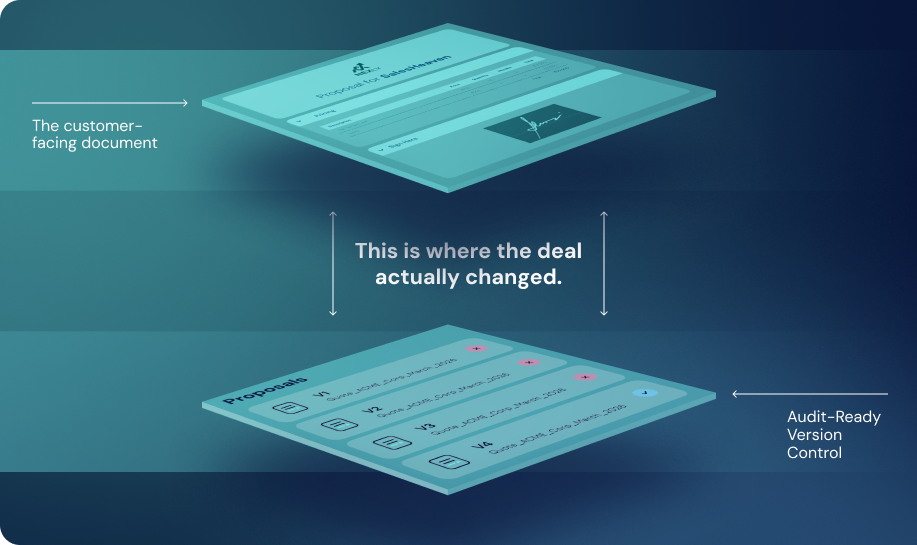
The cost surfaces late: billing disputes, revenue leakage, compliance exposure, and RevOps cleanup that consumes hours meant for strategy. But this is not an edge case. It is a documented pattern across organizations of every size. Reps download quotes as Word docs, edit them, and send them to customers. Finance discovers the mismatch when the signed contract comes back. The system of record is a liar. The real deal lives in email.
Factorial HR experienced this directly: Sales, Finance, and Legal operating on different data sets, creating friction at every handoff and billing errors that compounded over time. After moving to a unified governed execution model, they achieved a 50% reduction in finance incidents and 100% adoption across all three departments. The “distant cousins” became a single, connected revenue workflow.
The Approval Treadmill
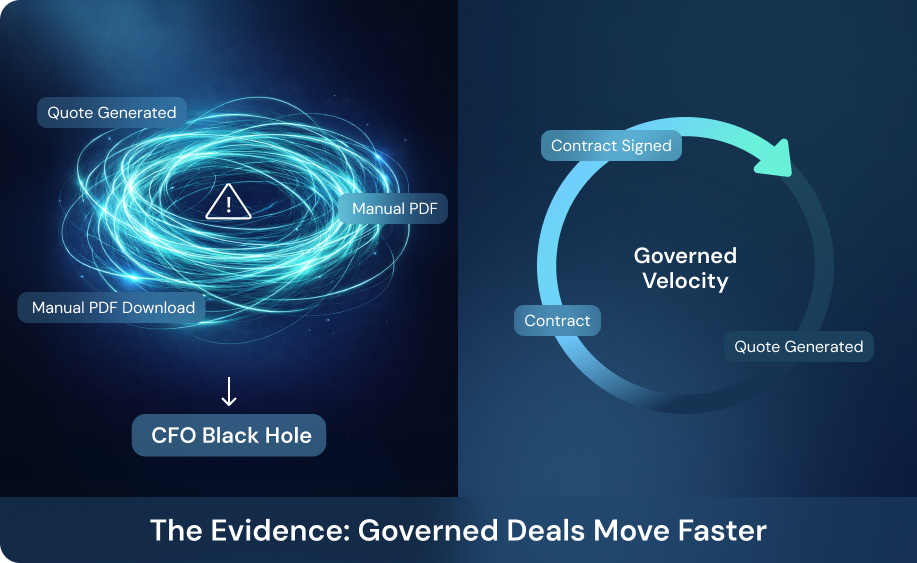
When a $500K deal requires four rounds of executive sign-off, a minor typo fix shouldn’t restart the clock. Rigid backend logic often triggers a “CFO Black Hole” for a simple payment term change. This treadmill trains reps to bypass the system entirely to avoid a 48-hour stall.
The rep, who has learned this lesson before, makes a different choice: they send a “corrected” version via email and hope nobody notices. The approval chain is bypassed entirely. The system records an approval that no longer reflects the deal.
The approval treadmill trains reps to work around the system, consumes executive time on decisions already made, and creates a culture where the approval process is treated as a formality rather than a governance mechanism. The cost: cycle time drag, executive credibility erosion, and a rep population that has learned the fastest path to close is the one that bypasses the system entirely.

9-Month Negotiation Leads to Post-Mortem Ops
In complex deals, redlines happen offline in Q2 and Q3, while the system only knows what happened in Q1. By Q4, the final contract bears no resemblance to the original sanction.
With no version history when the CFO asks for a report on discount justification, RevOps has to manually export a CSV of 200 deals and search Slack for terms like “competing against [Competitor]” or “end of quarter” to match justifications to deals. This is ‘Post-Mortem Ops.’ You’re spending your time reconstructing what happened six months ago for an auditor instead of building the strategy for next quarter.
For companies preparing for an IPO, a PE exit, or a board audit, this failure mode carries the highest stakes. Auditors ask for the chain of authority for the top 50 deals. RevOps produces a folder of PDF quotes and a separate spreadsheet of approvals. The auditors find 12 deals where the signed amount doesn’t match the approved amount. Valuation risk. Revenue that isn’t audit-ready is revenue built on sand.
Why “Automating Approvals” Doesn’t Fix This
Most CPQ vendors frame this as an automation problem: Route approvals faster. Send notifications to Slack. Speed up the chain.
But as a RevOps leader, you know the truth: Speeding up an email notification doesn’t change the fact that the rep already promised the discount. You aren’t governing the deal; you’re just getting a high-speed alert that your policy was already ignored.
The structural failure isn’t how fast approvals route, it is where the logic lives. When governance sits outside the deal; in email threads, Slack pings, or manual PDF reviews, it becomes a checkpoint that reps route around. Automation cannot reach what lives outside the system. And no amount of notification speed fixes the gap between what was approved and what was signed. Here is the difference:
The Old Way
The rep builds a quote in a spreadsheet or a brittle CPQ, saves it as a PDF, and then triggers an approval. If the CFO is slow to respond, the rep emails the “draft” PDF to the buyer anyway “just to keep things moving.” Governance is dead before the email is even sent.
The Governed Way
The business logic is encoded into the quote itself. If a rep enters a 40% discount, the “Generate DealRoom” and “Send to Customer” buttons literally disappear. They are replaced by a “Request Exception” button. The rep cannot physically create the artifact the buyer sees until the system, and the human, sanctions it.
Why Governing Beats Policing Deals
Policing is finding out a rep gave a 40% discount on a 20% approval after the deal is closed. Governing is the ‘Generate PDF’ button staying grayed out until the right person clicks ‘Approve’. This difference isn’t philosophical, it is operational. When governance is embedded, the system holds the decision at the point of configuration, ensuring the rep cannot send a quote that exceeds policy without a logged, attributed gate.


The governing equivalent of the CFO’s discount justification report is not a manual CSV export and a Slack search. It is a query. The rep could not even request the discount without selecting a justification code. That code, along with the specific context, is baked into the deal record and locked the moment the approver acts.
This is not about a CPQ or platform upgrade. It is a fundamental revenue governance capability
Policing |
Governing |
|
|---|---|---|
Source of Truth |
A collection of “final_final_v2.pdf” files and Slack threads |
The live, version-controlled deal record synced back to the CRM |
Approval Timing |
Chasing approvals after the fact |
Approvals enforced at the point of playbook configuration |
Audit Trail |
Reconstructing trails from inboxes and sent folders |
The trail is the workflow, logged in real time |
Compliance |
Reps find ways to route around the system |
Reps cannot send the quote without the approval |
Visibility |
Finance discovers mismatches at close |
What was signed is exactly what is in the system |
Management Style |
RevOps manages by exception (firefighting) |
RevOps manages by policy (strategic) |
Approver Context |
Whatever the rep chose to tell them |
Structured deal data presented at the point of approval |
One of the most under-appreciated costs of the policing model is what it does to approver quality. When an approver receives a Teams message asking them to sign off on a deal, they are approving based on what the rep chose to tell them, not on what the system shows. As one approver put it: “I don’t actually know the full context of the deal.” Governance that is embedded in the workflow presents the structured context at the point of approval. The approver sees the discount level, the payment terms, the non-standard clauses, and the deal history, not a summary written by the person who wants the approval.
Broken Governance Slows Deals Down
The Infrastructure Tax
Routing approvals through massive data repositories or generic workflow builders does not govern the deal. It simply creates a highly expensive alert system that operates outside the actual quoting environment.
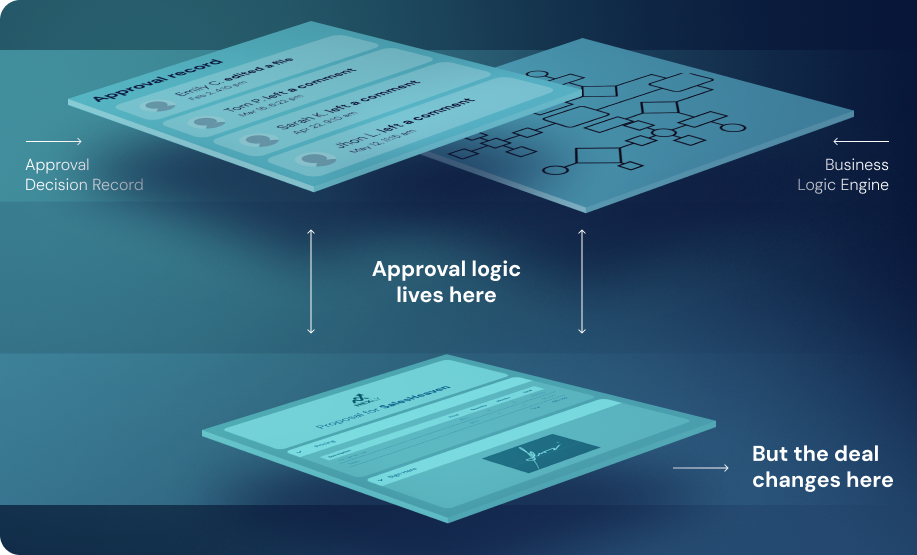
The biggest bottleneck is the preparation work ; the hours a rep spends explaining a deal because the CPQ failed to capture the context. When the system presents structured deal data at the point of approval, that manual labor disappears. Approvers get everything they need instantly, turning an approval process that took days into one that takes minutes.
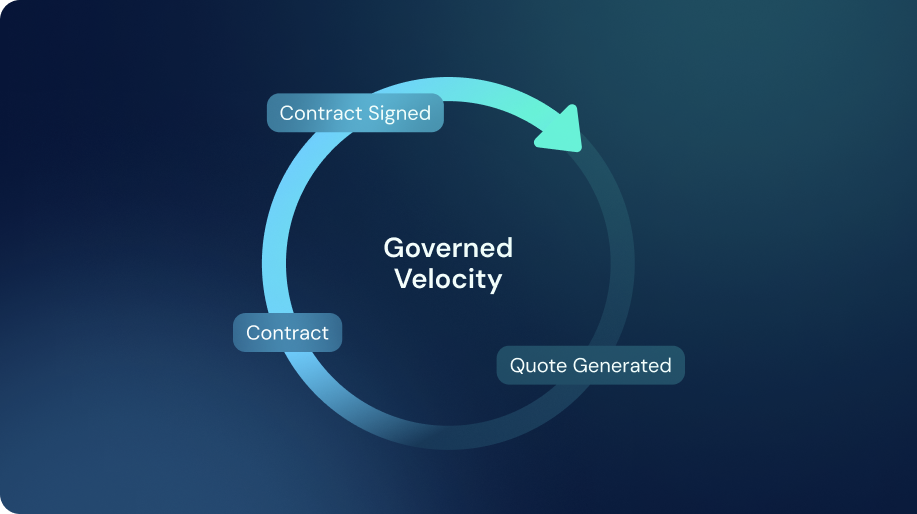
The Evidence: Governed Deals Move Faster
The proof is in the numbers. In every successful transition to governed execution, speed gains were not the product of fewer controls, but of clearer ones embedded directly within the execution flow. By removing the ambiguity that makes every approval a negotiation, organizations scale without adding “Deal Desk” headcount.
Deel, a global leader in payroll and compliance, cut quote processing time by 80% after moving to a governed execution model, reducing the time to close simple deals to just 10 minutes while maintaining full compliance across regional markets
Socure achieved a 70% reduction in quote-to-order cycle time, maintaining 90%+ quote accuracy without a dedicated Deal Desk as they scaled across new verticals. The mechanism in both cases was the same: governance embedded in the workflow, not bolted on as a review step afterward.
Zapier moved approval cycles from multi-day manual routing to ≤8 hours with parallel SLA-tracked flows, not by removing approvals, but by removing the ambiguity that made every approval a negotiation.
Built In eliminated their reliance on external consultants entirely, empowering RevOps to deploy pricing changes in 20 minutes rather than waiting weeks. “I can go into DealHub today and say, ‘No problem, I know what I need to do.’ I don’t have to wait two weeks. I can do it in 20 minutes.”
You Cannot Govern Revenue that Cannot Be Reconstructed
Revenue governance eventually moves beyond a RevOps headache or a Deal Desk inefficiency; it becomes an executive valuation risk. When an enterprise SaaS company preparing for an IPO or PE exit cannot validate the chain of authority for its top deals, it faces a critical question: What is this revenue actually worth if you cannot prove it was governed? Revenue that isn’t audit-ready is revenue built on sand.
This is not a theoretical exposure. Fragmented data in financial reporting is a recognized risk that investors are already pricing in. When RevOps produces a folder of PDF quotes and a separate spreadsheet of approvals that don’t match, it surfaces a “policing” failure that directly threatens valuation. To own the number, leadership must control the decisions that shape it.
This is not a theoretical exposure. Workiva’s 2026 Executive Benchmark Survey of nearly 1,500 finance and risk professionals found that almost all investors agree leaders underestimate the risk caused by fragmented data in financial reporting. The market is not waiting for the audit to surface the gap. It is already pricing it in.
The Compounding Cost of Deferred Governance
The reconstruction problem also compounds over time. Every quarter that passes without a system-enforced audit trail is another quarter of exceptions that become precedents, and precedents that become policy. The longer the organization waits, the harder it is to establish what “approved” actually means, because the system has no memory of the decisions that shaped it.
Governing revenue means the signed outcome matches what was sanctioned, and you can prove it without reconstruction. Not because someone did a thorough job of filing emails. Because the system recorded the decision at the moment it was made, locked the artifact after sign-off, and maintained a version history of every change that followed.
This is not a reporting capability it is a governance capability that separates revenue you own from revenue you merely audit.
When RevOps Governs Execution, the Business Owns its Revenue
The shift from policing to governing is not a process change; it is a structural one. It requires moving approval logic out of disconnected email threads and into the live deal workflow where decisions are actually made. When governance is embedded in the transaction path, RevOps transforms from a forensic function into a strategic one.
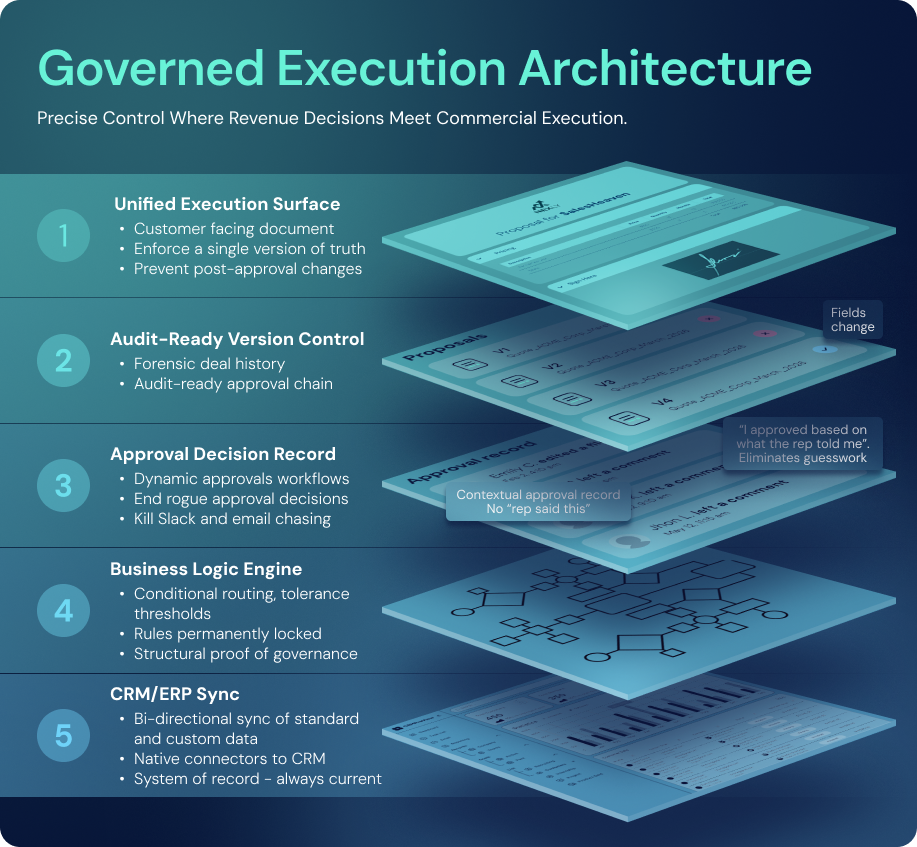
How DealHub Encodes Governance Into the Workflow
DealHub moves this governance into the live deal workflow through conditional routing and smart tolerance settings. By triggering approvers based on specific deal attributes—like discount levels or non-standard clauses—it removes manual intervention. Quote locking and version control ensure that what was approved stays approved, while the DealRoom provides a single auditable workspace for the entire negotiation history.
When every deal reflects what was actually sanctioned, RevOps can finally move from auditing revenue to owning it. You cannot own revenue you cannot reconstruct. Governed execution provides the accountability RevOps is responsible for and the defensible audit trail required to stand behind the business’s numbers.
The Revenue Governance Gap: Audit-Ready or Reconstructed?
Before investing in a solution, it is worth diagnosing exactly where your current process breaks. Governance failure isn’t always obvious; it often hides in the friction between your CRM and your actual deal negotiations. Identifying these gaps now is the only way to move from a “reconstructed” model to an “audit-ready” one.


Bridging this gap requires moving governance into the transaction path. By establishing a system that records decisions at the point of configuration, you ensure your revenue is owned, not just audited. Start by quantifying your specific risk level through our dedicated assessment.